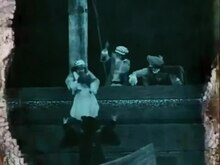
The Tempest is a
play by
William Shakespeare,
believed to have been written in 1610–11, and thought by many critics
to be the last play that Shakespeare wrote alone. It is set on a remote
island, where the sorcerer
Prospero, rightful
Duke of Milan, plots to restore his daughter
Miranda
to her rightful place using illusion and skilful manipulation. He
conjures up a storm, the eponymous tempest, to lure his usurping brother
Antonio and the complicit King Alonso of Naples to the island. There,
his machinations bring about the revelation of Antonio's lowly nature,
the redemption of the King, and the marriage of Miranda to Alonso's son,
Ferdinand.
There is no obvious single source for the plot of
The Tempest, but researchers have seen parallels in
Erasmus's Naufragium,
Peter Martyr's De orbe novo, and eyewitness reports by
William Strachey and Sylvester Jordain of the real-life shipwreck of the
Sea Venture on the islands of
Bermuda, and the subsequent conflict between
Sir Thomas Gates and
Sir George Somers. In addition, one of
Gonzalo's speeches is derived from
Montaigne's
essay Of the Canibales, and much of Prospero's renunciative speech is taken word for word from a speech by
Medea in
Ovid's poem
Metamorphoses. The
masque in Act 4 may have been a later addition, possibly in honour of the wedding of
Princess Elizabeth and
Frederick V in 1613. The play was first published in the
First Folio of 1623.
The story draws heavily on the tradition of the
romance, and it was influenced by
tragicomedy, the courtly
masque and perhaps the
commedia dell'arte. It differs from Shakespeare's other plays in its observation of a stricter, more organised
neoclassical style. Critics see
The Tempest
as explicitly concerned with its own nature as a play, frequently
drawing links between Prospero's "art" and theatrical illusion, and
early critics saw Prospero as a representation of Shakespeare, and his
renunciation of magic as signalling Shakespeare's farewell to the stage.
The play portrays Prospero as a rational, and not an occultist,
magician by providing a contrast to him in
Sycorax:
her magic is frequently described as destructive and terrible, where
Prospero's is said to be wondrous and beautiful. Beginning in about
1950, with the publication of
Psychology of Colonization by
Octave Mannoni,
The Tempest was viewed more and more through the lens of
postcolonial theory—exemplified in adaptations like
Aimé Césaire's Une Tempête set in
Haiti—and there is even a
scholarly journal on post-colonial criticism named after
Caliban.
The Tempest did not attract a significant amount of attention before the
ban on the performance of plays in 1642, and only attained popularity after the
Restoration,
and then only in adapted versions. In the mid-19th century, theatre
productions began to reinstate the original Shakespearean text, and in
the 20th century, critics and scholars undertook a significant
re-appraisal of the play's value, to the extent that it is now
considered to be one of Shakespeare's greatest works. It has been
adapted numerous times in a variety of styles and formats: in music, at
least 46 operas by composers such as
Fromental Halévy,
Zdeněk Fibich and
Thomas Adès; orchestral works by
Tchaikovsky,
Arthur Sullivan and
Arthur Honegger; and songs by such diverse artists as
Ralph Vaughan Williams,
Michael Nyman and
Pete Seeger; in literature,
Percy Bysshe Shelley's poem
With a Guitar, To Jane and
W. H. Auden's The Sea and the Mirror; novels by
Aimé Césaire and
The Diviners by
Margaret Laurence; in paintings by
William Hogarth,
Henry Fuseli, and
John Everett Millais; and on screen, ranging through a hand-tinted version of
Herbert Beerbohm Tree's 1905 stage performance, the science fiction film
Forbidden Planet in 1956,
Peter Greenaway's 1991
Prospero's Books featuring
John Gielgud as Prospero, to
Julie Taymor's
2010 film version which changed Prospero to Prospera (as played by
Helen Mirren), and
Des McAnuff's 2010 Stratford Shakespeare Festival production which starred
Christopher Plummer.
Characters
- Prospero, the main character. The overthrown Duke of Milan. He now lives on an island and is a great sorcerer.
- Miranda, Prospero's daughter, who falls in love with the Prince of Naples, Ferdinand.
- Ariel, a fierce and wicked sprite who does Prospero's bidding and is, at times, visible only to him. He became Prospero's "slave" because he was saved by Prospero from being trapped in a tree by Sycorax. Ariel obeys all of Prospero's demands and is eventually granted freedom.
- Caliban, a villainous island native, the deformed son of a witch named Sycorax (see below), who ruled the island before Prospero arrived. He now works as Prospero's
slave but despises him. In the play, he is known to have spoken many
colorful curses, an example being, "a southwest wind blow on ye and
blister you all o'er".
- Sycorax (unseen), a deceased Algerian sorceress and mother of Caliban, who was banished to the island before Prospero arrived and enslaved the spirits on the island, including Ariel.
- Iris, Ceres, and Juno, spirits who perform the roles of goddesses in a masque presented to the young lovers.
- Alonso, King of Naples
- Sebastian, Alonso's treacherous brother.
- Antonio, Prospero's brother, who usurped his position as Duke of Milan. He and Sebastian plot unsuccessfully to kill Alonso.
- Ferdinand, Alonso's son. Falls in love with Miranda.
- Gonzalo, a kindly Neapolitan courtier, who secretly provided Prospero and Miranda with food, water, books, and other "stuffs and necessaries" when they were pushed out to sea.
- Adrian and Francisco, lords.
- Trinculo, the King's jester and friend of Stephano.
- Stephano, the King's drunken butler and friend of Trinculo who tries to help Caliban overthrow his master
- Boatswain
- Master of the ship
Plot
The
magician,
Prospero, rightful Duke of
Milan, and his daughter,
Miranda, have been stranded for twelve years on an island after Prospero's jealous brother Antonio (aided by
Alonso, the King of
Naples)
deposed him and set him adrift with the 3-year-old Miranda. Gonzalo,
Alonso's counselor, had secretly supplied their boat with some food,
fresh water, "rich garments, linens, stuffs and necessaries", and
"volumes" (books) that Prospero prizes. Possessing magic powers due to
his great learning, Prospero is reluctantly served by a
spirit,
Ariel, whom Prospero had rescued from a tree in which he had been trapped by the cruel witch,
Sycorax,
after he had refused to obey her. Prospero maintains Ariel's loyalty by
repeatedly promising to release the "airy spirit" from servitude.
Sycorax had been exiled from Algiers to the island for wreaking havoc
with her magic, and had died before Prospero's arrival and without
releasing Ariel. Her son,
Caliban,
a deformed monster and the only non-spiritual inhabitant before the
arrival of Prospero, was initially adopted and raised by him. He taught
Prospero how to survive on the island, while Prospero and Miranda taught
Caliban religion and their own language. In slavery, Caliban has come
to view Prospero as a usurper and has grown to resent him and his
daughter. Prospero and Miranda in turn view Caliban with disappointment,
contempt and disgust. Prospero only performs one act of magic himself
directly on stage: he disarms Ferdinand, causing his nerves to become
"in their infancy again". The rest of his magic is through controlling
spirits (or mentioned as happening previously), which is how magicians
of the time were believed to operate.
Prospero, having divined that his brother Antonio is on a nearby
ship, has raised a tempest that causes the passengers to believe they
are shipwrecked and marooned. Also on the ship are Antonio's friend and
fellow conspirator, King Alonso of Naples, Alonso's brother and son
(Sebastian and Ferdinand, respectively) and Alonso's "trusted
counselor", Gonzalo. All these passengers are returning from the wedding
of Alonso's daughter Claribel and the King of
Tunis.
Prospero contrives to separate the shipwreck survivors into several
groups by his spells, and so Alonso and Ferdinand are separated, each
believing the other to be dead.
Three plots then alternate through the play. In one, Caliban falls in with
Stephano
and Trinculo, two drunkards, believing Stephano to be a "brave god" who
"bears celestial liquor". They attempt to raise a coup against
Prospero, which ultimately fails. In another, Prospero works to
encourage a romantic relationship between Ferdinand and Miranda; the two
fall immediately in love, but Prospero worries that "too light winning
[may] make the prize light", and compels Ferdinand to become his
servant, pretending that he regards him as a spy. In the third subplot,
Antonio and Sebastian conspire to kill Alonso and Gonzalo so that
Sebastian can become King. Ariel thwarts them, at Prospero's command.
Ariel appears to the "three men of sin" (Alonso, Antonio and Sebastian)
as a
harpy,
reprimanding them for their betrayal of Prospero. Prospero, who has
witnessed this, leaves to visit Ferdinand and Miranda. The three guilty
nobles run off, distracted and in a frenzy, and Gonzalo and the
attendant lords chase after to prevent them from doing "what this
ecstasy may now provoke them to".
Prospero then explains that he tested Ferdinand, and betroths a
willing Miranda to him. He then asks Ariel to bring some other spirits
and create a masque to entertain the young couple. These spirits present
a blessing by Iris, Ceres, and Juno, followed by dancing. Prospero
suddenly remembers the plot against his life, dismisses the spirits and
Miranda and Ferdinand, and sets a trap for Caliban, Trinculo, and
Stephano. They are chased offstage by goblins in the shape of hounds.
Prospero, all his enemies in his power, discovers that Ariel would
pity them if he were "human", and decides to forgive the people who
tried to kill him. He tells Ariel to fetch the nobles while he breaks
his charms.
In the conclusion, all the main characters are brought together
before Prospero, who forgives Alonso, Antonio and Sebastian. Ariel is
charged to prepare the proper sailing weather to guide the King's ship
back to the Royal fleet and then to Naples, where Ferdinand and Miranda
will be married. After discharging this task, Ariel will finally be
free. Prospero pardons Caliban, who is sent to prepare Prospero's cell,
to which Alonso and his party are invited for a final night before their
departure. (It is however not made clear whether, after their
departure, Caliban will remain on the island or whether he will be taken
to Naples). Prospero indicates that he intends to entertain them with
the story of his life on the island. Prospero has resolved to break and
bury his magic staff, and "drown" his book of magic, and in his
epilogue, shorn of his magic powers, he invites the audience to set him
free from the island with their applause.
Date and sources

A depiction from
Nicholas Rowe's 1709 edition of Shakespeare's plays of the stage direction of the opening of the 1674 adaptation
Date
The Tempest is thought by most scholars to have been written
in 1610–11, and is generally accepted as the last play that Shakespeare
wrote alone, although some have questioned either or both assertions. Scholars also note that it is impossible to determine if the play was written before, after, or at the same time as
The Winter's Tale, the dating of which has been equally problematic.
Edward Blount entered
The Tempest into the
Stationers' Register on 8 November 1623. It was one of 16 Shakespearean plays that Blount registered on that date.
Contemporary sources
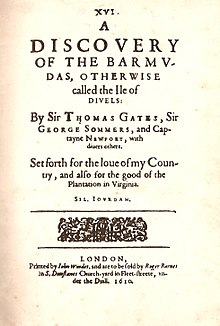
Sylvester Jourdain's A Discovery of the Barmudas
There is no obvious single
origin for the plot of
The Tempest; it seems to have been created out of an amalgamation of sources. Since source scholarship began in the 18th century, researchers have suggested passages from
Erasmus's Naufragium (1523), (translated into English 1606) and
Richard Eden's 1555 translation of
Peter Martyr's De orbo novo (1530). In addition,
William Strachey's
A True Reportory of the Wracke and Redemption of Sir Thomas Gates, Knight, an eyewitness report of the real-life shipwreck of the
Sea Venture in 1609 on the island of
Bermuda while sailing towards
Virginia,
is considered by most critics to be one of Shakespeare's primary
sources because of certain verbal, plot and thematic similarities.
Although not published until 1625, Strachey's report, one of several
describing the incident, is dated 15 July 1610, and critics say that
Shakespeare must have seen it in manuscript sometime during that year.
E.K. Chambers identified the
True Reportory as Shakespeare's "main authority" for
The Tempest, and the modern Arden editors say Shakespeare "surely drew" on Strachey and Montaigne for specific passages in the play. There has been, however, some scepticism about the alleged influence of Strachey in the play.
Kenneth Muir argued that although "[t]here is little doubt that Shakespeare had read ... William Strachey's
True Reportory"
and other accounts, "[t]he extent of the verbal echoes of [the Bermuda]
pamphlets has, I think, been exaggerated. There is hardly a shipwreck
in history or fiction which does not mention splitting, in which the
ship is not lightened of its cargo, in which the passengers do not give
themselves up for lost, in which north winds are not sharp, and in which
no one gets to shore by clinging to wreckage", and goes on to say that
"Strachey's account of the shipwreck is blended with memories of
Saint Paul's – in which too not a hair perished – and with Erasmus' colloquy."
Another
Sea Venture survivor, Sylvester Jourdain, also published an account,
A Discovery of The Barmudas dated 13 October 1610, and
Edmond Malone argued for the 1610–11 date on the account by Jourdain and the Virginia Council of London's
A True Declaration of the Estate of the Colonie in Virginia dated 8 November 1610.
Other sources
The Tempest may take its overall structure from traditional Italian
commedia dell'arte, which sometimes featured a
magus and his daughter, their supernatural attendants, and a number of rustics. The
commedia often featured a
clown known as
Arlecchino (or his predecessor,
Zanni) and his partner
Brighella,
who bear a striking resemblance to Stephano and Trinculo; a lecherous
Neapolitan hunchback who corresponds to Caliban; and the clever and
beautiful Isabella, whose wealthy and manipulative father,
Pantalone, constantly seeks a suitor for her, thus mirroring the relationship between Miranda and Prospero.
Gonzalo's description of his ideal society (2.1.148–157, 160–165) thematically and verbally echoes
Montaigne's
essay Of the Canibales, translated into English in a version published by
John Florio in 1603. Montaigne praises the society of the
Caribbean
natives: "It is a nation ... that hath no kinde of traffike, no
knowledge of Letters, no intelligence of numbers, no name of magistrate,
nor of politike superioritie; no use of service, of riches, or of
poverty; no contracts, no successions, no dividences, no occupation but
idle; no respect of kinred, but common, no apparrell but natural, no
manuring of lands, no use of wine, corne, or mettle. The very words that
import lying, falsehood, treason, dissimulation, covetousnes, envie,
detraction, and pardon, were never heard of amongst them." In addition, much of Prospero's renunciative speech (5.1.33–57) is taken word-for-word from a speech by
Medea in
Ovid's poem
Metamorphoses.

The first page of The Tempest, printed in the First Folio of 1623
Text
The Tempest presents relatively few textual problems in comparison with many of Shakespeare's other plays. First published in the
First Folio
in December 1623, the play is first in the volume, leading the section
of comedies. The play has more stage directions than any of
Shakespeare's other plays, though they appear to have been written for
readers instead of actors. Scholars infer from this that the editors of
the volume,
John Heminges and
Henry Condell, included the directions to aid readers, and they were not necessarily Shakespeare's. Scholars have also wondered about the
masque in Act 4, which some think was an interpolated afterthought, possibly added for the wedding of
Princess Elizabeth and
Frederick V
in 1613. However, other scholars see this as unlikely, arguing that
taking the masque out of the play creates more problems than it solves.
Themes and motifs
Our revels now are ended. These our actors,
As I foretold you, were all spirits and
Are melted into air, into thin air;
And—like the baseless fabric of this vision—
The cloud-capped towers, the gorgeous palaces,
The solemn temples, the great globe itself,
Yea, all which it inherit, shall dissolve,
And like this insubstantial pageant faded,
Leave not a rack behind. We are such stuff
As dreams are made on, and our little life
Is rounded with a sleep. ...
—Prospero[15]
The Theatre
The Tempest is explicitly concerned with its own nature as a
play, frequently drawing links between Prospero's art and theatrical
illusion; the shipwreck was a spectacle that Ariel performed, while
Antonio and Sebastian are cast in a troop to act. Prospero may even refer to the
Globe Theatre when he describes the whole world as an illusion: "the great globe ... shall dissolve ... like this insubstantial pageant". Ariel frequently disguises himself as figures from
Classical mythology, for example a
nymph, a
harpy, and
Ceres, acting as the latter in a
masque and
anti-masque that Prospero creates.
Early critics, such as
Thomas Campbell
in 1838, saw this constant allusion to the theatre as an indication
that Prospero was meant to represent Shakespeare; the character's
renunciation of magic thus signalling Shakespeare's farewell to the
stage. This theory persists among later critics, and remains solidly
within the critical canon.
Magic
Magic was a controversial subject in Shakespeare's day. In Italy in 1600,
Giordano Bruno, known for his occult interests, was burnt at the stake for heresy.
[clarification needed] Outside the Catholic world, in Protestant England where Shakespeare wrote
The Tempest, magic was also taboo; not all "magic", however, was considered evil.
[citation needed]
Several thinkers took a more rational approach to the study of the
supernatural, with the determination to discover the workings of unusual
phenomena. The German
Henricus Cornelius Agrippa was one such thinker, who published in
De Occulta Philosophia (1531, 1533) his observations of "divine" magic. Agrippa's work influenced Dr.
John Dee,
an Englishman and student of supernatural phenomena. When King James
took the throne, Dee found himself under attack for his beliefs, but was
able to defend himself successfully by explaining the divine nature of
his profession. However, he died in disgrace in 1608.

Ariel (Fuseli, c.1800–1810)
Shakespeare is also careful to make the distinction that Prospero
presents himself as a rational, and not an occultist, magician. He does
this by providing a contrast to him in Sycorax. Sycorax is said to have
worshipped the devil and been full of "earthy and abhored commands". She
was unable to control Ariel, who was "too delicate" for such dark
tasks. Prospero's rational goodness enables him to control Ariel where
Sycorax can only trap him in a tree. Sycorax's magic is frequently
described as destructive and terrible, where Prospero's is said to be
wondrous and beautiful. Prospero seeks to set things right in his world
through his magic, and once that is done, he renounces it, setting Ariel
free.
Of course, the problem is, Prospero never actually does any magical
acts. Only Ariel does. The magic of Prospero is a matter of language
alone.
The soul
The Tempest can be interpreted as Shakespeare's last treatise
on the human soul, in particular the Renaissance conception of the
tripartite soul divided into vegetative, sensitive, and rational
spheres, as described in
Plato's tripartite theory of soul and
Christian Philosophy. This was later also described in
Sigmund Freud's
id, ego and super-ego which was first linked to
The Tempest in the 1956 screenplay for
Forbidden Planet
by Cyril Hume, Irving Block, and Allen Adler. The film presents Caliban
reinterpreted as the 'monster from the Id', although the theory is
dismissed as 'obsolete' in that imagined future, and was also dismissed
by James E Phillips in 1964.
Prospero is exiled to an island with a symbol of his baser,
'vegetative' nature – Caliban – and his higher, 'sensitive' or
supernatural side – Ariel. Some productions have seen the same actor
play all three roles, making them symbols of the conflict within a fully
actualised or awakened Prospero – that between crude selfish
physicality and a higher, mystical side. In the screenplay for
Forbidden Planet it is revealed that the
id monster is an externalization of Dr Morbius' psyche.
According to this theory—one of many—for as long as Prospero is
battling with these qualities and lost in books, he is banished from
Milan. As the play finds its conclusion, he is both able to accept his
base, brutal nature ("this thing of darkness I acknowledge mine" he says
when taking responsibility for Caliban) while letting go of his
connection with higher, powerful forces ("then to the elements be free,
and fare thou well" he says, setting Ariel free). Abandoning magic and
acknowledging the brutal potential of his nature, he is allowed to
return to his rightful place as Duke, subject to agreement from the
audience: "as you from crimes would pardon'd be, let your indulgence set
me free."
Criticism and interpretation
Genre
The story draws heavily on the tradition of the
romance,
a fictitious narrative set far away from ordinary life. Romances were
typically based around themes such as the supernatural, wandering,
exploration and discovery. They were often set in coastal regions, and
typically featured exotic, fantastical locations and themes of
transgression and redemption, loss and retrieval, exile and reunion. As a
result, while
The Tempest was originally listed as a comedy in the
First Folio of Shakespeare's plays, subsequent editors have chosen to give it the more specific label of
Shakespearean romance. Like the other romances, the play was influenced by the then-new genre of
tragicomedy, introduced by
John Fletcher in the first decade of the 17th century and developed in the
Beaumont and Fletcher collaborations, as well as by the explosion of development of the courtly
masque form by such as
Ben Jonson and
Inigo Jones at the same time.
Dramatic structure
The Tempest differs from Shakespeare's other plays in its observation of a stricter, more organised
neoclassical style. The clearest indication of this is Shakespeare's respect for the
three unities in the play: the Unities of Time, Place, and Action.
Shakespeare's other plays rarely respected the three unities, taking
place in separate locations miles apart and over several days or even
years.
The play's events unfold in real time before the audience, Prospero
even declaring in the last act that everything has happened in, more or
less, three hours.
All action is unified into one basic plot: Prospero's struggle to
regain his dukedom; it is also confined to one place, a fictional
island, which many scholars agree is meant to be located in the
Mediterranean Sea. Another reading suggests that it takes place in the
New World, as some parts read like records of English and Spanish conquest in the Americas. Still others argue that the Island can represent any land that has been colonised.
Postcolonial
In Shakespeare's day, much of the world was still being discovered by
European seafarers, and stories were coming back from distant islands,
with myths about the Cannibals of the Caribbean, faraway
Edens, and distant tropical
Utopias. With the character
Caliban (whose name is almost an
anagram of
Cannibal and also resembles "
Cariban",
the term then used for natives in the West Indies), Shakespeare may be
offering an in-depth discussion into the morality of colonialism.
Different views of this are found in the play, with examples including
Gonzalo's Utopia,
Prospero's
enslavement of Caliban, and Caliban's subsequent resentment. Caliban is
also shown as one of the most natural characters in the play, being
very much in touch with the natural world (and modern audiences have
come to view him as far nobler than his two
Old World friends,
Stephano and Trinculo, although the original intent of the author may have been different). There is evidence that Shakespeare drew on
Montaigne's essay
Of Cannibals—which discusses the values of societies insulated from European influences—while writing
The Tempest.
Beginning in about 1950, with the publication of
Psychology of Colonization by
Octave Mannoni,
The Tempest was viewed more and more through the lens of
postcolonial
theory. This new way of looking at the text explored the effect of the
coloniser (Prospero) on the colonised (Ariel and Caliban). Though Ariel
is often overlooked in these debates in favour of the more intriguing
Caliban, he is nonetheless an essential component of them. The French writer
Aimé Césaire, in his play
Une Tempête sets
The Tempest in
Haiti, portraying Ariel as a
mulatto
who, unlike the more rebellious Caliban, feels that negotiation and
partnership is the way to freedom from the colonisers. Fernandez Retamar
sets his version of the play in
Cuba,
and portrays Ariel as a wealthy Cuban (in comparison to the lower-class
Caliban) who also must choose between rebellion or negotiation.
Although scholars have suggested that his dialogue with Caliban in Act
two, Scene one, contains hints of a future alliance between the two when
Prospero leaves, Ariel is generally viewed by scholars as the good
servant, in comparison with the conniving Caliban—a view which
Shakespeare's audience may well have shared.
Ariel is used by some postcolonial writers as a symbol of their efforts
to overcome the effects of colonisation on their culture. For example,
Michelle Cliff,
a Jamaican author, has said that she tries to combine Caliban and Ariel
within herself to create a way of writing that represents her culture
better. Such use of Ariel in postcolonial thought is far from uncommon;
the spirit is even the namesake of a
scholarly journal covering post-colonial criticism.
Feminist
The Tempest has only one female character, Miranda. Other women, such as Caliban's mother
Sycorax,
Miranda's mother and Alonso's daughter Claribel, are only mentioned.
Because of the small role women play in the story in comparison to other
Shakespeare plays,
The Tempest has attracted much feminist
criticism. Miranda is typically viewed as being completely deprived of
freedom by her father. Her only duty in his eyes is to remain chaste.
Ann Thompson argues that Miranda, in a manner typical of women in a
colonial atmosphere, has completely internalised the patriarchal order
of things, thinking of herself as subordinate to her father.
The less-prominent women mentioned in the play are subordinated as
well, as they are only described through the men of the play. Most of
what is said about Sycorax, for example, is said by Prospero. Further,
Stephen Orgel notes that Prospero has never met Sycorax – all he learned
about her he learned from Ariel. According to Orgel, Prospero's
suspicion of women makes him an unreliable source of information. Orgel
suggests that he is sceptical of female virtue in general, citing his
ambiguous remark about his wife's fidelity.
However, certain goddesses such as Juno, Ceres, Iris, and sea nymphs are in one scene of the play.
Performance History
Shakespeare's day
A record exists of a performance of
The Tempest on 1 November 1611 by the
King's Men before
James I and the English royal court at
Whitehall Palace on
Hallowmas
night. The play was one of the six Shakespearean plays (and eight
others for a total of 14) acted at court during the winter of 1612–13 as
part of the festivities surrounding the marriage of Princess
Elizabeth with
Frederick V, the
Elector of the Palatinate of the Rhine. There is no further public performance recorded prior to the
Restoration; but in his 1669 preface to the Dryden/Davenant version, John Dryden states that
The Tempest had been performed at the
Blackfriars Theatre. Careful consideration of stage directions within the play supports this, strongly suggesting that the play was written with
Blackfriars Theatre rather than the
Globe Theatre in mind.
Restoration and 18th century
Adaptations of the play, not Shakespeare's original, dominated the performance history of
The Tempest from the
English Restoration until the mid-19th century. All theatres were closed down by the
puritan government during the
Commonwealth. Upon the restoration of the monarchy in 1660, two
patent companies—the
King's Company and the
Duke's Company—were established, and the existing theatrical repertoire divided between them.
Sir William Davenant's
Duke's Company had the rights to perform
The Tempest. In 1667 Davenant and
John Dryden made heavy cuts and adapted it as
The Tempest or, The Enchanted Island.
They tried to appeal to upper-class audiences by emphasising royalist
political and social ideals: monarchy is the natural form of government;
patriarchal authority decisive in education and marriage; and
patrilineality preeminent in inheritance and ownership of property.
They also added characters and plotlines: Miranda has a sister, named
Dorinda; and Caliban a sister, also named Sycorax. As a parallel to
Shakespeare's Miranda/Ferdinand plot, Prospero has a foster-son,
Hippolito, who has never set eyes on a woman. Hippolito was a popular
breeches role, a man played by a woman, popular with Restoration theatre management for the opportunity to reveal actresses' legs. Scholar Michael Dobson has described
Enchanted Island
as "the most frequently revived play of the entire Restoration" and as
establishing the importance of enhanced and additional roles for women.
In 1674,
Thomas Shadwell re-adapted Dryden and Davenant's
Enchanted Island
as an opera, usually meaning a play with sections that were to be sung
and/or danced. Restoration playgoers appear to have regarded the
Dryden/Davenant/Shadwell version as Shakespeare's:
Samuel Pepys, for example, described it as "an old play of Shakespeares" in his
diary. The opera was extremely popular, and "full of so good variety, that I cannot be more pleased almost in a comedy" according to Pepys.
The Prospero in this version is very different from Shakespeare's:
Eckhard Auberlen describes him as "reduced to the status of a
Polonius-like
overbusy father, intent on protecting the chastity of his two sexually
naive daughters while planning advantageous dynastic marriages for
them."
Enchanted Island was successful enough to provoke a parody,
The Mock Tempest, written by Thomas Duffett for the
King's Company in 1675. It opened with what appeared to be a tempest, but turns out to be a riot in a brothel.

A playbill for a 1757 production of The Tempest at the Drury Lane Theatre Royal
In the early 18th century, the Dryden/Davenant/Shadwell version
dominated the stage. Ariel was—with two exceptions—played by a woman,
and invariably by a graceful dancer and superb singer. Caliban was a
comedian's role, played by actors "known for their awkward figures". In
1756,
David Garrick staged another operatic version, a "three-act extravaganza" with music by
John Christopher Smith.
The Tempest was one of the staples of the repertoire of
Romantic Era theatres.
John Philip Kemble produced an acting version which was closer to Shakespeare's original, but nevertheless retained Dorinda and Hippolito.
Kemble was much-mocked for his insistence on archaic pronunciation of
Shakespeare's texts, including "aitches" for "aches". It was said that
spectators "packed the pit, just to enjoy hissing Kemble's delivery of
'I'll rack thee with old cramps, / Fill all they bones with aches'."
The actor-managers of the Romantic Era established the fashion for
opulence in sets and costumes which would dominate Shakespeare
performances until the late 19th century: Kemble's Dorinda and Miranda,
for example, were played "in white ornamented with spotted furs".
In 1757, a year after the debut of his operatic version,
David Garrick produced a heavily cut performance of Shakespeare's script at
Drury Lane, and it was revived, profitably, throughout the century.
19th century
It was not until
William Charles Macready's
influential production in 1838 that Shakespeare's text established its
primacy over the adapted and operatic versions which had been popular
for most of the previous two centuries. The performance was particularly
admired for
George Bennett's performance as Caliban; it was described by Patrick MacDonnell—in his
An Essay on the Play of The Tempest published in 1840—as "maintaining in his mind, a strong resistance to that tyranny, which held him in the thraldom of slavery".
The
Victorian era
marked the height of the movement which would later be described as
"pictorial": based on lavish sets and visual spectacle, heavily cut
texts making room for lengthy scene-changes, and elaborate stage
effects. In
Charles Kean's 1857 production of
The Tempest, Ariel was several times seen to descend in a ball of fire. The hundred and forty stagehands supposedly employed on this production were described by the
Literary Gazette as "unseen ... but alas never unheard".
Hans Christian Andersen also saw this production and described Ariel as "isolated by the electric ray", referring to the effect of a
carbon arc lamp directed at the actress playing the role. The next generation of producers, which included
William Poel and
Harley Granville-Barker, returned to a leaner and more text-based style.
In the late 19th and early 20th centuries, Caliban, not Prospero, was perceived as the star act of
The Tempest, and was the role which the actor-managers chose for themselves.
Frank Benson researched the role by viewing monkeys and baboons at the zoo; on stage, he hung upside-down from a tree and gibbered.
20th century and beyond
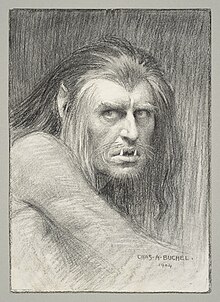
A charcoal drawing by Charles Buchel of Herbert Beerbohm Tree as Caliban in the 1904 production.
Continuing the late-19th-century tradition, in 1904
Herbert Beerbohm Tree wore
fur and
seaweed to play
Caliban, with waist-length hair and
apelike bearing, suggestive of a primitive part-animal part-human stage of
evolution. This "
missing link" portrayal of Caliban became the norm in productions until
Roger Livesey, in 1934, was the first actor to play the role with black makeup. In 1945
Canada Lee played the role at the
Theatre Guild in New York, establishing a tradition of black actors taking the role, including
Earle Hyman in 1960 and
James Earl Jones in 1962.
In 1916,
Percy MacKaye presented a community
masque,
Caliban by the Yellow Sands, at the
Lewisohn Stadium in New York. Amidst a huge cast of dancers and masquers, the
pageant
centres on the rebellious nature of Caliban but ends with his plea for
more knowledge ("I yearn to build, to be thine Artist / And 'stablish
this thine Earth among the stars- / Beautiful!") followed by
Shakespeare, as a character, reciting Prospero's "Our revels now are
ended" speech.
John Gielgud played
Prospero numerous times, and called it his favourite role.
Douglas Brode describes him as "universally heralded as ... [the 20th] century's greatest stage Prospero". His first appearance in the role was in 1930: he wore a
turban, later confessing that he intended to look like
Dante. He played the role in three more stage productions, lastly at the
Royal National Theatre in 1974.
Derek Jacobi's Prospero for
The Old Vic in 2003 was praised for his portrayal of isolation and pain in ageing.
Peter Brook directed an experimental production at the
Round House in 1968, in which the text was "almost wholly abandoned" in favour of
mime. According to Margaret Croydon's
review,
Sycorax was "portrayed by an enormous woman able to expand her face and body to still larger proportions – a fantastic emblem of the
grotesque ... [who] suddenly ... gives a horrendous yell, and Caliban, with black
sweater over his head, emerges from between her legs: Evil is born."
In spite of the existing tradition of a black actor playing Caliban opposite a white Prospero,
colonial interpretations of the play did not find their way onto the stage until the 1970s. Performances in England directed by
Jonathan Miller and by
Clifford Williams explicitly portrayed Prospero as
coloniser.
Miller's production was described, by David Hirst, as depicting "the
tragic and inevitable disintegration of a more primitive culture as the
result of European invasion and colonisation". Miller developed this approach in his 1988 production at the
Old Vic in London, starring
Max von Sydow
as Prospero. This used a mixed cast made up of white actors as the
humans and black actors playing the spirits and creatures of the island.
According to
Michael Billington,
"von Sydow's Prospero became a white overlord manipulating a mutinous
black Caliban and a collaborative Ariel keenly mimicking the gestures of
the island's invaders. The colonial metaphor was pushed through to its
logical conclusion so that finally Ariel gathered up the pieces of
Prospero's abandoned staff and, watched by awe-struck tribesmen, fitted
them back together to hold his wand of office aloft before an
immobilised Caliban.
The Tempest suddenly acquired a new political dimension unforeseen by Shakespeare."
Psychoanalytic interpretations have proved more difficult to depict on stage.
Gerald Freedman's production at the
American Shakespeare Theatre in 1979 and Ron Daniels'
Royal Shakespeare Company
production in 1982 both attempted to depict Ariel and Caliban as
opposing aspects of Prospero's psyche. However neither was regarded as
wholly successful:
Shakespeare Quarterly,
reviewing Freedman's production, commented, "Mr. Freedman did nothing
on stage to make such a notion clear to any audience that had not heard
of it before."
In 1988,
John Wood played Prospero for the
RSC, emphasising the character's human complexity. The
Financial Times reviewer described him as "a demented
stage manager
on a theatrical island suspended between smouldering rage at his
usurpation and unbridled glee at his alternative ethereal power".
Japanese theatre styles have been applied to
The Tempest. In 1988 and again in 1992
Yukio Ninagawa brought his version of
The Tempest to the UK. It was staged as a rehearsal of a
Noh
drama, with a traditional Noh theatre at the back of the stage, but
also using elements which were at odds with Noh conventions. In 1992,
Minoru Fujita presented a
Bunraku (Japanese puppet) version in
Osaka and at the
Tokyo Globe.
Sam Mendes directed a 1993
RSC production in which
Simon Russell Beale's Ariel was openly resentful of the control exercised by
Alec McCowen's Prospero. Controversially, in the early performances of the run, Ariel spat at Prospero, once granted his freedom. An entirely different effect was achieved by
George C. Wolfe in the outdoor
New York Shakespeare Festival production of 1995, where the casting of
Aunjanue Ellis as Ariel opposite
Patrick Stewart's
Prospero charged the production with erotic tensions. Productions in
the late 20th-century have gradually increased the focus placed on
sexual tensions between the characters, including Prospero/Miranda,
Prospero/Ariel, Miranda/Caliban, Miranda/Ferdinand and Caliban/Trinculo.

Caliban rants at Prospero while Ariel looks on, in a 2014 production by OVO theatre company,
St Albans, UK
The Tempest was performed at the
Globe Theatre in 2000 with
Vanessa Redgrave
as Prospero, playing the role as neither male nor female, but with
"authority, humanity and humour ... a watchful parent to both Miranda
and Ariel." While the audience respected Prospero,
Jasper Britton's Caliban "was their man" (in Peter Thomson's words), in spite of the fact that he spat fish at the
groundlings, and singled some of them out for humiliating encounters. By the end of 2005,
BBC Radio had aired 21 productions of
The Tempest, more than any other play by Shakespeare. Several critics feel that the play is autobiographical.
Trevor Nunn, in the PBS miniseries
Shakespeare Uncovered,
states that he feels that Prospero is meant to represent Shakespeare
himself, and that Prospero's final farewell to magic is really
Shakespeare's final farewell to his audience.
The Cirque du Soleil touring production
Amaluna is inspired by
The Tempest.
Music
The Tempest has more music than any other Shakespeare play,
and has proved more popular as a subject for composers than most of
Shakespeare's plays. Scholar Julie Sanders ascribes this to the
"perceived 'musicality' or lyricism" of the play.
Two settings of
songs from
The Tempest which may have
been used in performances during Shakespeare's lifetime have survived.
These are "Full Fathom Five" and "Where The Bee Sucks There Suck I" in
the 1659 publication
Cheerful Ayres or Ballads, in which they are attributed to
Robert Johnson, who regularly composed for the King's Men.
It has been common throughout the history of the play for the producers
to commission contemporary settings of these two songs, and also of
"Come Unto These Yellow Sands".
The Tempest has also influenced songs written in the
folk and
hippie traditions: for example, versions of "Full Fathom Five" were recorded by
Marianne Faithfull for
Come My Way in 1965 and by
Pete Seeger for
Dangerous Songs!? in 1966.
[84] The Decemberists'
song "The Island: Come and See/The Landlord's Daughter/You'll Not Feel
The Drowning" is thought by many to be based on the story of Caliban and
Miranda.
Michael Nyman's
Ariel Songs are taken from his score for the film
Prospero's Books.
Among those who wrote
incidental music to
The Tempest were:
- Arthur Sullivan: His graduation piece, completed in 1861, was a set of incidental music to "The Tempest". Revised and expanded, it was performed at The Crystal Palace in 1862, a year after his return to London, and was an immediate sensation.
- Ernest Chausson: in 1888 he wrote incidental music for La tempête, a French translation by Maurice Bouchor. This is believed to be the first orchestral work that made use of the celesta.
- Jean Sibelius: his 1926 incidental music was written for a lavish production at the Royal Theatre in Copenhagen. An epilogue was added for a 1927 performance in Helsinki.
He represented individual characters through instrumentation choices:
particularly admired was his use of harps and percussion to represent
Prospero, said to capture the "resonant ambiguity of the character".
- Malcolm Arnold, Lennox Berkeley, Arthur Bliss, Engelbert Humperdinck, Hector Berlioz, Willem Pijper and Henry Purcell.
At least forty-six
operas or
semi-operas based on
The Tempest exist. In addition to the Dryden/Davenant and Garrick versions mentioned in the "Restoration and 18th century" section above,
Frederic Reynolds produced an operatic version in 1821, with music by Sir
Henry Bishop. Other pre-20th-century operas based on
The Tempest include
Fromental Halévy's
La Tempesta (1850) and
Zdeněk Fibich's
Bouře (1894).
In the 20th century,
Kurt Atterberg's
Stormen premiered in 1948 and
Frank Martin's
Der Sturm in 1955.
Michael Tippett's 1971 opera
The Knot Garden, contains various allusions to
The Tempest.
In Act 3, a psychoanalyst, Mangus, pretends to be Prospero and uses
situations from Shakespeare's play in his therapy sessions.
John Eaton, in 1985, produced a fusion of live
jazz with pre-recorded electronic music, with a libretto by Andrew Porter.
Michael Nyman's 1991 opera
Noises, Sounds & Sweet Airs was first performed as an
opera-ballet by
Karine Saporta. This opera is unique in that the three vocalists, a
soprano,
contralto, and
tenor,
are voices rather than individual characters, with the tenor just as
likely as the soprano to sing Miranda, or all three sing as one
character.
The soprano who sings the part of Ariel in
Thomas Adès'
21st-century opera is stretched at the higher end of the register, highlighting the
androgyny of the role.
Mike Silverman of the Associated Press commented, "Ades has made the
role of the spirit Ariel a tour de force for coloratura soprano, giving
her a vocal line that hovers much of the time well above high C."
Luca Lombardi's
Prospero was premiered 2006 at Nuremberg Opera House. Ariel is sung by 4
female voices (S,S,MS,A) and has an instrumental alter ego on stage
(flute). There is an instrumental alter ego (cello) also for Prospero.
Choral settings of excerpts from
The Tempest include
Amy Beach's
Come Unto These Yellow Sands (
SSAA, from
Three Shakespeare Songs), Matthew Harris'
Full Fathom Five,
I Shall No More to Sea, and
Where the Bee Sucks (
SATB, from
Shakespeare Songs, Books I, V, VI), Ryan Kelly's
The Tempest (
SATB, a setting of the play's Scene I),
Jaakko Mäntyjärvi's
Full Fathom Five and
A Scurvy Tune (
SATB, from
Four Shakespeare Songs and
More Shakespeare Songs),
Frank Martin's
Songs of Ariel (
SATB),
Ralph Vaughan Williams'
Full Fathom Five and
The Cloud-capp'd Towers (
SATB, from
Three Shakespeare Songs), and
David Willcocks'
Full Fathom Five (
SSA).
Orchestral works for concert presentation include
Pyotr Ilyich Tchaikovsky's fantasy
The Tempest (1873), Fibich's symphonic poem
Bouře (1880),
John Knowles Paine's symphonic poem
The Tempest (1876),
Benjamin Dale's overture (1902),
Arthur Honegger's orchestral prelude (1923), and
Egon Wellesz's
Prosperos Beschwörungen (five works 1934–36).
Ballet sequences have been used in many performances of the play since Restoration times. A one-act ballet of
The Tempest by choreographer
Alexei Ratmansky was premiered by
American Ballet Theatre set to the incidental music of
Jean Sibelius on October 30, 2013 in New York City.
Ludwig van Beethoven's 1802
Piano Sonata No. 17 in D minor,
Op. 31, No. 2, was given the subtitle "The Tempest" some time after
Beethoven's death because, when asked about the meaning of the sonata,
Beethoven was alleged to have said "Read
The Tempest". But this story comes from his associate
Anton Schindler, who is often not trustworthy.
Stage musicals derived from
The Tempest have been produced. A production called
The Tempest: A Musical was produced at the
Cherry Lane Theatre in New York City in December 2006, with a concept credited to
Thomas Meehan and a script by Daniel Neiden (who also wrote the songs) and
Ryan Knowles. Neiden had previously been connected with another musical, entitled
Tempest Toss’d. In September 2013,
The Public Theater produced a new large-scale stage musical at the
Delacorte Theater in
Central Park, directed by Lear deBessonet with a cast of more than 200.
Literature and art
Percy Bysshe Shelley was one of the earliest poets to be influenced by
The Tempest.
His "With a Guitar, To Jane" identifies Ariel with the poet and his
songs with poetry. The poem uses simple diction to convey Ariel's
closeness to nature and "imitates the straightforward beauty of
Shakespeare's original songs". Following the publication of
Darwin's ideas on
evolution, writers began to question mankind's place in the world and its relationship with God. One writer who explored these ideas was
Robert Browning, whose poem "
Caliban upon Setebos" (1864) sets Shakespeare's character pondering theological and philosophical questions. The French philosopher
Ernest Renan wrote a closet drama,
Caliban: Suite de La Tempête (
Caliban: Sequel to The Tempest),
in 1878. This features a female Ariel who follows Prospero back to
Milan, and a Caliban who leads a coup against Prospero, after the
success of which he actively imitates his former master's virtues.
W. H. Auden's "long poem"
The Sea and the Mirror takes the form of a reflection by each of the supporting characters of
The Tempest on their experiences. The poem takes a
Freudian viewpoint, seeing Caliban (whose lengthy contribution is a
prose poem) as Prospero's
libido.
In 1968 Franco-Caribbean writer
Aimé Césaire published
Une Tempête,
a radical adaptation of the play based on its colonial and postcolonial
interpretations, in which Caliban is a black rebel and Ariel is
mixed-race. The figure of Caliban influenced numerous works of African
literature in the 1970s, including pieces by
Taban Lo Liyong in Uganda, Lemuel Johnson in Sierra Leone,
Ngũgĩ wa Thiong'o in Kenya, and David Wallace of Zambia's
Do You Love Me, Master?. A similar phenomenon occurred in late 20th-century Canada, where several writers produced works inspired by Miranda, including
The Diviners by
Margaret Laurence,
Prospero's Daughter by Constance Beresford-Howe and
The Measure of Miranda by Sarah Murphy. Other writers have feminised Ariel (as in
Marina Warner's novel
Indigo) or Caliban (as in
Suniti Namjoshi's sequence of poems
Snaphots of Caliban).
From the mid-18th century, Shakespeare's plays, including
The Tempest, began to appear as the subject of paintings. In around 1735,
William Hogarth produced his painting
A Scene from The Tempest: "a baroque, sentimental fantasy costumed in the style of Van Dyck and Rembrandt".
The painting is based upon Shakespeare's text, containing no
representation of the stage, nor of the (Davenant-Dryden centred) stage
tradition of the time.
Henry Fuseli, in a painting commissioned for the
Boydell Shakespeare Gallery (1789) modelled his Prospero on
Leonardo da Vinci.
These two 18th-century depictions of the play indicate that Prospero
was regarded as its moral centre: viewers of Hogarth's and Fuseli's
paintings would have accepted Prospero's wisdom and authority.
John Everett Millais's
Ferdinand Lured by Ariel (1851) is among the
Pre-Raphaelite paintings based on the play. In the late 19th century, artists tended to depict Caliban as a
Darwinian "missing-link", with fish-like or ape-like features, as evidenced in
Noel Paton's
Caliban.
Charles Knight produced the
Pictorial Edition of the Works of Shakespeare
in eight volumes (1838–43). The work attempted to translate the
contents of the plays into pictorial form. This extended not just to the
action, but also to images and metaphors: Gonzalo's line about
"mountaineers dewlapped like bulls" is illustrated with a picture of a
Swiss peasant with a
goitre. In 1908,
Edmund Dulac produced an edition of
Shakespeare's Comedy of The Tempest with a scholarly plot summary and commentary by
Arthur Quiller-Couch,
lavishly bound and illustrated with 40 watercolour illustrations. The
illustrations highlight the fairy-tale quality of the play, avoiding its
dark side. Of the 40, only 12 are direct depictions of the action of
the play: the others are based on action before the play begins, or on
images such as "full fathom five thy father lies" or "sounds and sweet
airs that give delight and hurt not".
Fantasy writer
Neil Gaiman based a story on the play in one issue of his comics series
The Sandman. The comic stands as a sequel to the earlier
Midsummer Night's Dream
issue. This issue follows Shakespeare over a period of several months
as he writes the play, which is named as his last solo project, as the
final part of his bargain with the Dream King to write two plays
celebrating dreams. The story draws many parallels between the
characters and events in the play and Shakespeare's life and family
relationships at the time. It is hinted that he based Miranda on his
daughter
Judith Shakespeare and Caliban on her suitor
Thomas Quiney.
In the comic
Locke & Key, by writer
Joe Hill and co-creator and artist
Gabriel Rodriguez,
the main characters father, Rendell Locke and his groups of friends in
the school, stage a production of Shakespeare's The Tempest in 1988, in
which they used the Keys during the play's performance to create a grand
spectacle.
Ilium (novel) and its sequel
Olympos (novel) by
Dan Simmons is heavily influenced by
The Tempest, a portion of the plot devoted to a re-imagining of
The Tempest's characters in a distant sci-fi future.
Screen
The Tempest first appeared on the screen in 1905.
Charles Urban filmed the opening storm sequence of
Herbert Beerbohm Tree's version at
Her Majesty's Theatre for a
2 1⁄2-minute
flicker, whose individual frames were hand-tinted, long before the invention of colour film. In 1908, Percy Stowe directed a
Tempest running a little over ten minutes, which is now a part of the
British Film Institute's compilation
Silent Shakespeare.
Much of its action takes place on Prospero's island before the storm
which opens Shakespeare's play. At least two other silent versions,
one from 1911 by
Edwin Thanhouser, are known to have existed, but have been lost. The plot was adapted for the Western
Yellow Sky, directed by
William A. Wellman, in 1946.
The 1956 science fiction film
Forbidden Planet set the story on a planet in space,
Altair IV, instead of an island. Professor Morbius (
Walter Pidgeon) and his daughter Altaira (
Anne Francis)
are the Prospero and Miranda figures (both Prospero and Morbius having
harnessed the mighty forces that inhabit their new homes). Ariel is
represented by the helpful Robbie the Robot, while Sycorax is replaced
with the powerful race of the Krell. Caliban is represented by the
dangerous and invisible "monster from the id", a projection of Morbius'
psyche born from the Krell technology instead of Sycorax's womb.
In the opinion of Douglas Brode, there has only been one screen "performance" of
The Tempest since the silent era, he describes all other versions as "variations". That one performance is the
Hallmark Hall of Fame version from 1960, directed by
George Schaefer, and starring
Maurice Evans as Prospero,
Richard Burton as Caliban,
Lee Remick as Miranda and
Roddy McDowall as Ariel. It cut the play to slightly less than ninety minutes. Critic Virginia Vaughan praised it as "light as a
soufflé, but ... substantial enough for the main course."
In 1979, animator
George Dunning, director of
Yellow Submarine, planned an animated version of
The Tempest; but died while working on it.
Also in 1979,
Derek Jarman produced a homoerotic
Tempest
that used Shakespeare's language, but was most notable for its
deviations from Shakespeare. One scene shows a corpulent and naked
Sycorax (
Claire Davenport) breastfeeding her adult son Caliban (
Jack Birkett). The film reaches its climax with
Elisabeth Welch belting out
Stormy Weather. The central performances were
Toyah Willcox' Miranda and
Heathcote Williams' Prospero, a "dark brooding figure who takes pleasure in exploiting both his servants".
Several other television versions of the play have been broadcast; among the most notable is the 1980
BBC Shakespeare production, virtually complete, starring
Michael Hordern as Prospero.
Paul Mazursky's 1982 modern-language adaptation of
The Tempest,
with Philip Dimitrius (Prospero) as a disillusioned New York architect
who retreats to a lonely Greek island with his daughter Miranda after
learning of his wife Antonia's infidelity with Alonzo, dealt frankly
with the sexual tensions of the characters' isolated existence. The
Caliban character, the goatherd Kalibanos, asks Philip which of them is
going to have sex with Miranda.
John Cassavetes played Philip,
Raul Julia Kalibanos,
Gena Rowlands Antonia and
Molly Ringwald Miranda.
Susan Sarandon
plays the Ariel character, Philip's frequently bored girlfriend Aretha.
The film has been criticised as "overlong and rambling", but also
praised for its good humour, especially in a sequence in which
Kalibanos' and his goats dance to
Kander and Ebb's
New York, New York.
John Gielgud has written that playing Prospero in a film of
The Tempest was his life's ambition. Over the years, he approached
Alain Resnais,
Ingmar Bergman,
Akira Kurosawa, and
Orson Welles to direct.
Eventually, the project was taken on by
Peter Greenaway, who directed
Prospero's Books (1991) featuring "an 87-year-old John Gielgud and an impressive amount of nudity". Prospero is reimagined as the author of
The Tempest, speaking the lines of the other characters, as well as his own. Although the film was acknowledged as innovative in its use of
Quantel Paintbox to create visual tableaux, resulting in "unprecedented visual complexity", critical responses to the film were frequently negative:
John Simon called it "contemptible and pretentious".
The Swedish-made animated film from 1989 called "Resan till Melonia" (directed by
Per Åhlin)
is an adaptation of the Shakespeare play, focusing on ecologial values.
"Resan till Melonia" was critically acclaimed for its stunning visuals
drawn by Åhlin and its at times quite dark and nightmare-like sequences,
even though the film was originally marketed for children.
Closer to the spirit of Shakespeare's original, in the view of critics such as Brode, is
Leon Garfield's abridgement of the play for
S4C's 1992
Shakespeare: The Animated Tales series. The 29-minute production, directed by
Stanislav Sokolov and featuring
Timothy West as the voice of Prospero, used
stop-motion puppets to capture the fairy-tale quality of the play. Disney's animated feature
Pocahontas has been described as a "politically corrected"
Tempest. Another "offbeat variation" (in Brode's words) was produced for
NBC in 1998:
Jack Bender's
The Tempest featured
Peter Fonda as Gideon Prosper, a Southern slave-owner forced off his plantation by his brother shortly before the
Civil War.
A magician who has learned his art from one of his slaves, Prosper uses
his magic to protect his teenage daughter and to assist the Union Army.
The
PBS series
Wishbone featured a television adaptation of "The Tempest" in its episode "Shakespaw" with Wishbone as Ariel.
In
Julie Taymor's 2010 film version of
The Tempest, Prospero is a woman named Prospera, played by
Helen Mirren.
South London was the setting for
Rob Curry
and Anthony Fletcher's 2012 mockumentary version of "The Tempest",
which used the themes arising from Shakespeare's connection with the
discovery of the
New World to explore contemporary multicultural Britain – particularly with regard to the
London riots of 2011.
The
Stratford Shakespeare Festival of Canada presented a version in 2010 in which
Christopher Plummer played Prospero. It was subsequently filmed in hi-def and is now available on DVD.
The anime and manga series
Blast of Tempest was heavily influenced by
The Tempest and
Hamlet.
Where several dialogues and plot elements pays homage to the two works
of Shakespeare, which are two stories of retribution, albeit with
completely opposing outcome.
References
All references to
The Tempest, unless otherwise specified, are taken from the
Arden Shakespeare Third Series, based on the
First Folio text of 1623. Under its referencing system, 4.1.148 means act 4, scene 1, line 148.